Author: admin

What dimensions do I need when planning my staircase?

In order to be able to select a suitable staircase, the following dimensions are particularly relevant:

  • Basic dimensions (A): The space available for your staircase is a decisive factor in determining which models are suitable. It is best to measure the length and width of the space available for the stairs on the floor of the room. Using the floor plan of the room can help here.
  • Dimensions of the ceiling opening (B): The diameter of spiral staircases, the width of space-saving staircases and the dimensions of the hatch box for loft staircases must be chosen to match the ceiling opening. Therefore, be sure to measure the length and width of your ceiling opening before purchasing your staircase. For system staircases, please note that the ceiling opening must be 10 cm larger than the dimensions of the staircase. For example, a spiral staircase with a diameter of 140 cm requires a ceiling opening with a length and width of 150 cm.
  • Room height: The room height is also an important parameter for planning a staircase. Here a distinction must be made between two dimensions:
    • Storey height (C): The floor height is measured from the top edge of the floor to the top edge of the ceiling or gallery. It is the determining factor for the choice of system staircases.
    • Clear room height (D): For loft ladders, on the other hand, the clear room height is the essential parameter. It is measured from the upper edge of the floor to the lower edge of the ceiling.
  • Ceiling thickness (E): The ceiling thickness is also particularly relevant for the installation of attic stairs. To find it out, simply measure from the lower edge of the ceiling to the upper edge of the ceiling.
  • Fold-out space (F): It should be noted that attic stairs usually require a certain amount of space to fold out. This area exceeding the basic dimension is called the fold-out space.
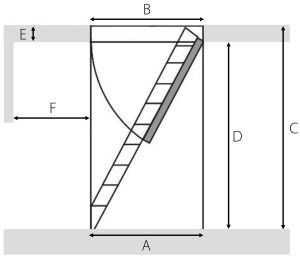
Technical drawing showing key dimensions for a staircase: A (floor opening length), B (ceiling opening width), C (floor-to-ceiling height), D (floor-to-opening height), E (ceiling thickness), and F (horizontal clearance for stair unfolding).

What is the best way to plan my staircase?

Planning a staircase usually happens in a few simple steps. First, it’s important to understand the basic conditions: where will the staircase be installed, and what will you use it for? For example, it makes a difference whether the staircase is intended for indoor or outdoor use. How often you’ll be going up and down the stairs also plays a key role in choosing the right type of staircase.

Based on that, you can either decide on a type of staircase right away or start by measuring the available space. These two steps go hand in hand – the staircase should match your expectations, but it also needs to fit into the space you have.

Once the measurements are taken and the type of staircase is defined, you can start looking for a suitable model. Minka offers a wide range of spiral staircases, space-saving staircases, outdoor staircases, and attic staircases. Feel free to browse our models online or ask for Minka products at a DIY store near you.

What types of stairs are there?

Minka offers a wide range of different staircase types. In general, we distinguish between system staircases and attic staircases. System staircases include spiral staircases, space-saving staircases, and outdoor staircases. Attic staircases mainly differ in terms of materials and construction. Below is an overview of the key features of each staircase type:

Spiral staircases
Minka’s product range includes many spiral staircases made of wood and metal. These staircases feature a central spindle to which the steps are attached, with the handrail mounted on the outer edge of the steps. Spiral staircases are particularly space-saving and represent a special type of spiral stair. In contrast, classic spiral staircases are open in the center and usually have railings on both sides.

Space-saving staircases
Space-saving staircases are ideal when limited space is available for access to the next floor. Depending on the model, they can be installed straight, slightly turned, or as a quarter-turn staircase. A special variant is the central spine staircase, where the steps are supported by a single beam along the center line, allowing for very flexible installation.

Outdoor staircases
Only staircases that are clearly designed for outdoor use are suitable for exterior areas. With these models, both the steps and railings are galvanized, making them highly resistant to weather and environmental conditions. Minka offers both straight outdoor staircases and spiral staircases for outdoor use.

Attic staircases
Attic staircases (also known as loft ladders, folding staircases, or retractable staircases) are not intended for constant use and can be folded away after use. They are ideal for accessing unoccupied spaces, such as attics. Minka offers various designs, including wooden and metal attic staircases. A special type of metal attic staircase is the scissor staircase, which opens via a scissor mechanism and can be easily pulled down.

Flat roof staircases
Accessing a flat roof requires a staircase with a dedicated flat roof exit. In these models, the top cover is made of galvanized metal, ensuring reliable protection against wind and weather.

Winding staircase

A spiral staircase has an almost circular course and winds upwards around an open centre point. This open centre is also called the stair eye. The spiral staircase, on the other hand, has a metal spindle in the middle to which the steps are attached.

Galvanised

Our exterior staircases are made of galvanised metal parts. This means that the materials are coated with a layer of zinc to make them corrosion-resistant, hard-wearing and weatherproof.

U-value

The U-value is an important term when selecting loft ladders and flat roof exits. It provides information about the insulating performance of a material. Therefore, it is also called thermal insulation value or heat transfer coefficient.

The U-value describes the amount of energy or heat that flows through a material when there are different temperatures on both sides of the material. The unit of the U-value is W/m2K (watts per square metre and kelvin). The lower the U-value, the more the material insulates.

Stair shoes

Stair shoes are the plastic attachments at the bottom of attic stairs or ladders. They ensure that the wood or metal of the stairs does not wear down and also prevent scratches on the floor.